

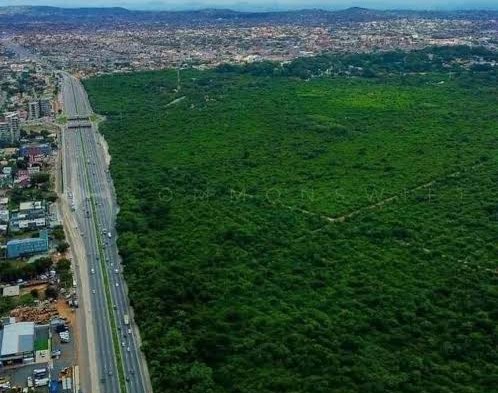
Is Accra losing its major green buffer zone which doubles as air purifier within the city since 1927? This was the question running through the minds of most Ghanaians a few years ago.
Originally covering an area of 495 hectares, the Achimota Forest Reserve was created as a green belt between the Capital City and the Achimota School. This natural resource was reduced to 355 hectares and facing further depletion.
The Achimota Forest Reserve plays an important role in protecting the environment, improving air quality and serving as a green buffer for Accra and nearby communities.
In this regard, the authorities during the pre-independence era saw the need to prepare an ecological area where much human activities will be restricted, which will in turn serve as a field laboratory for schools, providing a place of recreation and conserving biological diversity within the Accra city and its environs.
This idea was put into action when the government acquired the land from the Owoo Family (original owners of the land) in 1927, for this purpose. The Achimota Forest Reserve was classified as a forest reserve and accordingly gazetted in 1939.
This forest reserve is the only major green belt within Accra which is sandwiched by the Achimota School to the West, Ghana Institute of Management and Public Administration (GIMPA) to the East, Christian Village on the northern side with George Walker Bush Highway on the southern part.
The entire forest area is located in the Okai Kwei North Municipality in the Greater Accra Region of Ghana. It is approximately 7.6 kilometers from the central business city of Accra.
Ensuring its usage for the purpose of its acquisition, the entire area was protected against unauthorized usage such as poaching, hunting, logging and construction of houses and other commercial facilities.
Later, the undesirable state of the forest reserve caused some residents living within Accra and its environs to raise concern as to whether the green belt was being replaced with the usual concrete structures which has now become the order of the day. Large portion of lands within urban areas in Ghana are made up of concrete structures and Accra is no exception.
A study carried out by Adams Osman of the Department of Geography Education, University of Education, Winneba, Ghana shows the current trends and efficiency of land consumption in the Greater Accra Region from 1987 to 2017. The study shows that artificial surfaces has increased from 4.2% to 33.1%, with an annual growth rate of 22.1% in 30 years.
Another study published in 2018 by Alex Barimah Owusu of the University of Ghana estimated that Accra lost 65% of its urban vegetation between 1986 and 2013.
This phenomenon means more vegetation is giving way to concrete surfaces within the capital city and its environs. More trees are being cut off to pave way for the construction of houses and other commercial entities.
In 2005, the Environmental Protection Agency linked nearly 3,000 deaths in Accra to air pollution. According to the agency, this figure could rise to 4,600 deaths by 2030 if no control measures are put in place to check the level of pollution.
Currently, Accra has been ranked among countries in the world with moderate air pollution by IQAir, an international partner agency of UN-HABITAT, UNEP, GREENPEACE and US Green Building Council (USGBC) as a result of the Air Quality Index. This placed Accra in 492nd position out of all cities ranked worldwide in relation to air quality.
In the agency’s estimation, Accra is a city that has some fairly bad pollution issues, with several months on record in years past that would put many members of its population in danger, due to the highly damaging effects that pollution exposure can bring, particularly to vulnerable members of the society.
The facts surrounding the condition of the Achimota Forest Reserve was that government released more lands than what was agreed in 2007 and have also decided to commit another large portion to the creation of an Eco – Park.
It can be recalled that in 2007, the Owoo Family petitioned the then government to release the un-used portions of the forest in the southern periphery to the family in lieu of compensation, which had not been paid over the years since 1927 when the land was acquired.
In 2008, the government agreed to lease 90 acres of the southern periphery of the forest to the family for a period of 99 years. However, this was not activated.
In 2011, the Owoo Family again petitioned the government on the same issue and another committee was constituted to look into the petition. After the government was satisfied with the family’s application, 361 acres of land (instead of the original 90 acres), was released in September 2013.
Within the same period, the government working through the Forestry Commission also decided to convert some portions of the forest into an Eco-Park which calls for the amendment of the 1930 Instrument which classified the entire area as a forest reserve.
An Executive Instrument (E.I.) 144 on April 19, 2022 therefore lifted the 1927 classification of those portions of the Achimota Forest in the southern periphery as a Forest Reserve. The E.I. 144 was published together with the Forests (Achimota Firewood Plantation Forest Reserve) (Amendment) Instrument, 2022 (E.I. 154).
The E.I. 144 was to make the peripheral portions of the forest reserve a declassified zone to ensure a development that was consistent with the area of the forest reserve. Furthermore, the E.I. 154 on the other hand states emphatically that, the area of the forest shall remain a forest reserve. Both instruments contain adequate provisions that seek to protect the ecological integrity of the forest reserve.
Meanwhile 889 acres of forest land has been officially declared as the remaining forest reserve since 40% (361 acres) of the southern periphery has been handed over.
This decision generated public fury and criticism from environmental groups, civil society organizations (CSOs) and some Members of Parliament (MPs), who called for the reversal of the decision in order to restore the forest to its protected status.
The individuals and institutions argued that declassifying the forest reserve is a dangerous step; explaining further that “we spend almost 100 years to reach 27% encroachment and now with one swoop of a pen, we are giving out 70%, that is not acceptable.”.
Further information provides that the Achimota Forest Reserve under the International Union for Conservation of Nature (IUCN) is a classified area and thus limit the use of the land for certain activities. Due to that, Ghana’s IUCN obligation on development allowed forest reserves to primarily focus on agriculture, forestry and tourism.
The question in the minds of most Ghanaians is that if the original plan by government in 2007 is to lease 90 acres of the forest land for 99 years as agreed, why does the E.I. 144 (2022) give out 361 acres of land?
Secondly, is the E.I. 154 (2022) meant to protect and preserve the remaining of the forest reserve or to continue the usual depletion?
As Ghanaians pondered over this issue then came the relief from the current cabinet of revoking the Executive Instrument (E.I.) 144, restoring the Achimota Forest Reserve to its fully protected status and reversing the decision that removed part of the forest from the reserve.
This decision on June 24, 2026 to restore the forest to its original classification under the 1927 declaration brings an end to the legal tussle introduced since 2022 that excised about 361 acres from the southern periphery of the reserve.
As Ghanaians, we need to remember the wise saying that “When the last tree dies, the last man dies”.
Writer: Isaac Shinne Ametepe, Public Relations Unit, National Folklore Board









Leave a Reply