

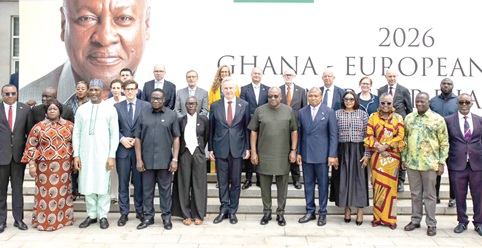
The Minister of Foreign Affairs, Samuel Okudzeto Ablakwa, has stated that the government is willing to work out a reciprocal e-visa fee reduction with European Union (EU) countries for the mutual benefit of the two sides.
He said Ghana was open to “a reciprocal discussion” on the subject.
Responding to the EU’s concern over Ghana’s new e-visa fees, Mr Ablakwa said visa fees were approved by Parliament under the Fees and Charges Act, but the government would “convince our colleagues in Parliament” if EU member states reduce their own fees.
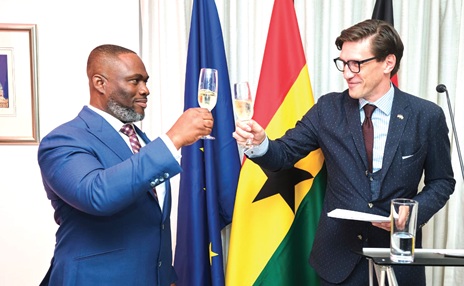
Speaking at the opening session of the Ghana-EU Partnership Dialogue in Accra last Thursday, Mr Ablakwa said Ghana-EU relations were at an “all-time high”, with the two parties deepening relations in recent times.
“From the foundations established in development cooperation, the partnership has evolved to embrace trade, investment, governance, climate action, peace and security, and human development. The partnership is today comprehensive and forward-looking,” he said.
He indicated that trade volumes had improved remarkably in excess of a billion dollars, with the EU remaining a cherished trading partner.
President John Dramani Mahama delivered the keynote address at the dialogues, which also atracted a high ministerial participation
Mr Ablakwa said the year under review had been “exciting”, as Ghana became the first African country to formalise a Security and Defence Partnership Agreement with the EU, and also the first African country to secure sustainable timber certification under the Forest Law Enforcement, Governance and Trade (FLEGT) process.
“We were the second country, only after Indonesia, to secure what the experts say is a very, very complicated certification,” he stated.
The minister said the government was proud to have played a leading role under President Mahama’s leadership as African Union (AU) champion on reparatory justice, which led to United Nation (UN) Resolution A/RES/80/250 declaring the trafficking of enslaved Africans as the gravest crime against humanity.
He said cooperation with the EU since the resolution had been constructive.
“Key EU partners like France have taken the lead in openly committing to work with Ghana to achieve the objectives of the UN Resolution. And President Macron will be addressing virtually the Next Steps Conference that President Mahama has convened from the 17th to the 19th of this month,” he said.
He said the Dutch government had presented a catalogue of artefacts identified for retention and return, while Germany was fully represented and would return some artefacts obtained from the Volta Region.
The Catholic Church and the Church of Scotland, the minister said, had also issued formal apologies, with Pope Leo XIV affirming the resolution’s principles.
“Ghana does not seek to create divisions or to open wounds. That approach has given all our international partners the confidence that they need to work with us on this important UN resolution,” Mr. Ablakwa said.
Mr. Ablakwa said Ghana-EU projects were now aligned with the President’s Reset Agenda, including the 24-Hour Economy initiative, Feed Ghana Programme and the Women’s Development Bank.
Mr Ablakwa said his ministry was closely following the new EU Pact on Migration and Asylum intended to take effect on June 12, and expressed the hope that its implementation would be humane.
“We are willing to work with the EU to address particularly irregular migration.
We want to have stronger laws, stronger enforcement to deal with human trafficking,” he said.
He condemned the recruitment of Ghanaian youth by some European nations to fight wars.
With President Mahama set to chair the African Union from February, next year, Mr Ablakwa said Ghana wanted synergies with the EU ahead of the next AU-EU Dialogue.
Source: graphic.com.gh




Leave a Reply